


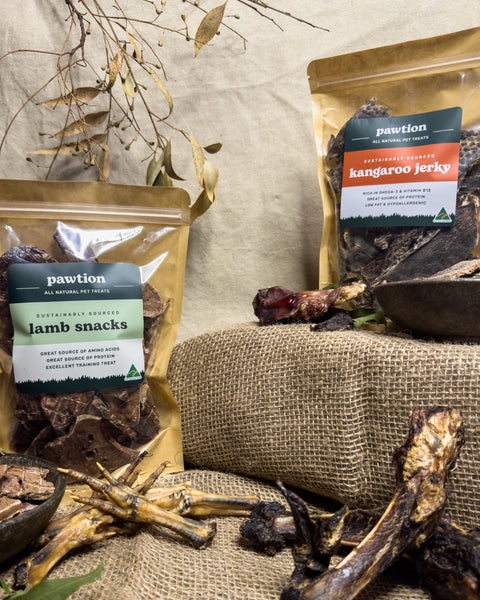
You’ve probably seen “air-dried” on the label of your dog’s favourite Pawtion treats and thought, “Yeah, sounds good — but what does that actually mean?” You’re not alone. It’s one of the most common questions we get, and it deserves a proper answer. Because the way a treat is made matters just as much as what goes into it.
So let’s pull back the curtain on how Pawtion treats go from a single, fresh Australian-sourced ingredient to a crunchy, tail-wagging reward — made right here in Australia, start to finish.
Air-drying, explained simply
Air-drying is exactly what it sounds like: using gently moving air at low temperatures to slowly draw moisture out of fresh meat. No deep-frying, no high-heat baking, no chemical preservatives to extend shelf life. Just air and time.
Think of it like making jerky the old-fashioned way — but in a controlled, accredited facility instead of someone’s backyard. The process typically takes many hours, and the temperature stays low enough to avoid cooking the protein in the traditional sense. That’s the key difference between air-drying and standard kibble manufacturing, where ingredients are often extruded at extreme heat (sometimes above 150°C).
Why does temperature matter? Because heat destroys things. Vitamins, enzymes, amino acids, and the natural flavours that make a dog lose their mind over a treat — high heat degrades all of them. Air-drying preserves far more of what nature put into the ingredient in the first place.
The result is a treat that’s shelf-stable (no fridge needed), lightweight, and nutrient-dense. It has a firm, chewy or crunchy texture depending on the cut — and if your dog’s nose starts twitching the second you open the bag, that’s because the natural aroma hasn’t been baked out of it.
How Pawtion does it
Every Pawtion treat starts with a single ingredient sourced from Australian farms, fisheries, and waters. That’s it. One protein, nothing added — and it never leaves the country from paddock to packet.
Our treats are slowly air-dried in a HACCP, Safe Food and FDA-accredited facility right here in Australia. That alphabet soup of accreditations means the facility meets the same food safety standards used for human food production — including hazard analysis at every step, regular independent audits, and strict hygiene controls.
That’s an important distinction, because plenty of brands label their treats “Australian-made” while quietly importing their ingredients from overseas. With Pawtion, both the sourcing and the manufacturing happen locally. The kangaroo is Australian, the sardines are Australian, the chicken is Australian — and so is the facility that turns them into treats.
Here’s what happens, step by step:
The fresh ingredient (say, kangaroo, chicken, or whole sardines) arrives at the facility. It’s trimmed, portioned, and laid out on drying racks. Low-temperature air circulates slowly and evenly around the pieces, drawing out moisture over an extended period. Once the moisture content drops to the right level — low enough to be shelf-stable, high enough to keep the texture appealing — the treats are inspected, packed fresh, and sealed.
No additives. No preservatives. No fillers, flavourings, or binding agents. The reason the treats don’t spoil on the shelf isn’t a chemical trick — it’s because bacteria need moisture to grow, and air-drying removes enough of it to keep the treat safe naturally.
That’s also why you can read the ingredients list on any Pawtion pack in about two seconds. There’s only one thing on it.
Air-dried vs freeze-dried vs dehydrated: what’s the difference?
These three terms get thrown around interchangeably, but they’re actually different processes with different outcomes.
Air-dried treats are dried slowly using circulating air at low temperatures. The texture tends to be firm and chewy — similar to jerky. Nutrients are well-preserved because the heat stays low. This is Pawtion’s method.
Freeze-dried treats are flash-frozen first, then placed in a vacuum chamber where the ice sublimates (turns from solid to gas without becoming liquid). The result is a very lightweight, brittle, crunchy texture that can be crumbled easily. Nutrient preservation is excellent, but the texture is quite different — almost chalky when dry, and freeze-dried treats tend to rehydrate quickly in water.
Dehydrated treats use heat — often higher than air-drying — to evaporate moisture. This is the method closest to traditional oven-drying. Depending on the temperature used, some nutrient loss can occur, and the texture is often harder and more brittle than air-dried.
Each method has its place. Freeze-dried works brilliantly as a crumbly training treat or meal topper. Dehydrated can produce a satisfying crunch. But for a single-ingredient chew or treat where you want the protein to hold its shape, retain its natural flavour, and deliver a chewing experience your dog will actually work at — air-drying is hard to beat.
Why air-drying matters for your dog’s health
It’s easy to skim past manufacturing methods and focus on the ingredients list, but the process genuinely affects what your dog gets out of the treat.
More bioavailable nutrients. Because air-drying doesn’t blast the ingredient with extreme heat, heat-sensitive vitamins (like B-group vitamins), amino acids, and natural enzymes are better preserved. Your dog’s body can actually absorb and use more of what’s in the treat.
No need for artificial preservatives. The removal of moisture is the preservation method. There’s no sodium nitrite, no BHA, no ethoxyquin, no “preservative blend” hiding in the fine print. For pet parents trying to avoid unnecessary chemicals, this is a big deal.
Intense natural flavour. If you’ve ever wondered why your pup goes absolutely bonkers for an air-dried sardine but gives a supermarket biscuit a polite sniff and walks away — this is why. The natural oils and aromas are locked in, not cooked out.
Easier on sensitive stomachs. Single ingredient, minimally processed, no additives. For dogs with allergies or dietary sensitivities, air-dried single-protein treats make it simple to control exactly what your dog is eating. If your pup reacts to something, you know precisely what it was — because there’s only one ingredient to rule out.
What to look for when buying air-dried treats
Not all products labelled “air-dried” are created equal. Here are a few things worth checking:
The ingredient count. A genuine single-ingredient air-dried treat will list one thing: the protein. If you see glycerine, salt, “natural flavour,” or vegetable starch on the label, the product has additives — even if the front of the pack says “natural.”
The accreditation. Look for HACCP certification at a minimum. This means the facility has a documented food safety plan with critical control points monitored at every stage. Bonus points for Safe Food and FDA accreditation on top of that.
The country of origin — and the country of sourcing. These are two different things, and the label doesn’t always make it obvious. A product can be legally “made in Australia” using ingredients shipped in from China, South America, or anywhere else. The manufacturing happens here; the animal protein didn’t. If provenance matters to you — and for a lot of pet parents, it does — look for brands that are both Australian-made and Australian-sourced. Pawtion is both: every protein comes from Australian farms and fisheries, and every treat is produced in an accredited Australian facility.
The texture. Air-dried treats should feel firm and dense, not rock-hard or powdery. A proper air-dried chew has a bit of give when you bend it. If it snaps cleanly like a cracker, it may have been dehydrated at higher heat or over-dried.
A note on the smell
Let’s address the elephant in the room — or rather, the sardine in the living room. Air-dried treats smell. That’s actually a feature, not a bug. The natural oils and aromas that make your dog obsessed are the same ones your nose picks up when you open the bag.
The intensity varies by protein. Fish treats tend to be the most aromatic (looking at you, mackerel). Chicken and kangaroo are milder. But across the board, the smell is a sign that the treat hasn’t been bleached, deodorised, or cooked into flavourless oblivion. Your dog’s nose will thank you, even if yours needs a moment.
Keep treats sealed in their resealable bag, stored in a cool, dry spot, and you’ll find the aroma stays where it belongs — in the bag until treat time.
FAQs
Is air-dried the same as raw?
No. Air-drying removes enough moisture to make the treat shelf-stable and eliminates the bacterial risks associated with raw feeding. The low heat used during the process provides a gentle kill step without the nutrient destruction of high-temperature cooking.
How long do air-dried treats last?
Unopened, most air-dried treats last 12 months or more. Once opened, they’ll stay fresh for several weeks when stored in their sealed bag in a cool, dry place. No refrigeration needed.
Are air-dried treats safe for puppies?
Generally yes, though it depends on the specific treat and your puppy’s size and chewing style. Softer air-dried treats (like jerky or small fish) tend to be easier for younger dogs. Harder chews (like trachea or femur bones) are better suited to adult dogs with fully developed teeth. Always supervise your pup with any new chew.
Can cats eat air-dried treats?
Absolutely. Many of Pawtion’s air-dried treats — particularly whole sardines, mackerel slivers, and chicken hearts — are great for cats and dogs alike. The single-ingredient format makes them a simple, protein-rich reward for feline fur babies too.
Why are air-dried treats more expensive than kibble-style treats?
The process takes longer, uses higher-quality whole ingredients (rather than rendered meals or by-products), and doesn’t rely on cheap fillers to bulk up the product. You’re paying for actual protein, not cereal and flavouring.
Are Pawtion treats Australian-sourced or just Australian-made?
Both. Every protein in our range is sourced from Australian farms and fisheries, and every treat is produced in an accredited facility here in Australia. A lot of brands can say “Australian-made” while importing their ingredients — we don’t do that. From paddock (or ocean) to packet, the whole process stays local.
Ready to see (and smell) the difference?
If you’ve been curious about what air-dried treats actually are, hopefully this clears things up. The short version: it’s a slow, gentle process that preserves the good stuff in a single Australian-sourced ingredient, made in an accredited Australian facility — no nasties, no imported mystery protein, no shortcuts.
Your pup already knows. They’ve been trying to tell you with every tail wag, every hopeful stare at the treat bag, every inexplicable ability to hear a resealable pouch being opened from three rooms away.